Relaxed
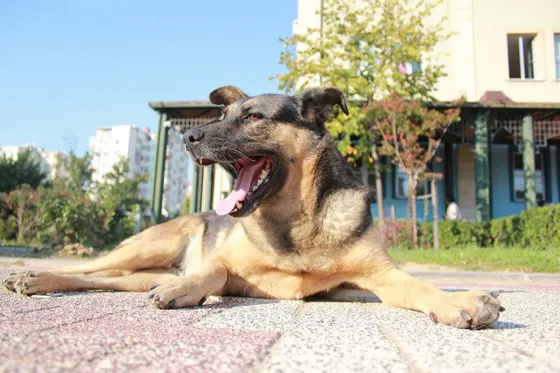
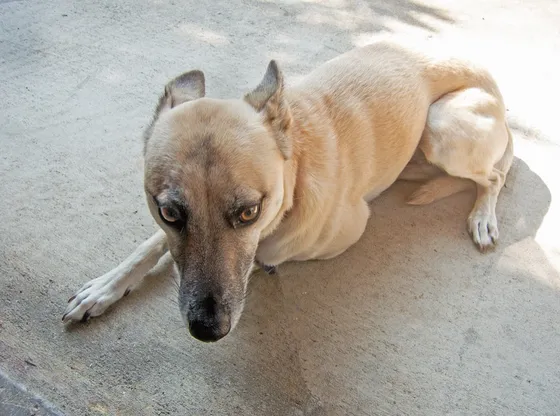
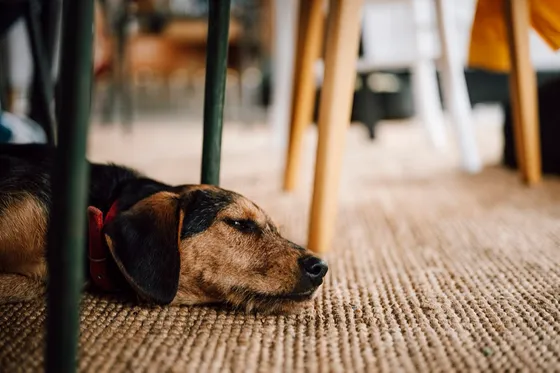
Loose, wiggly body. Weight evenly balanced. Tail at its natural height. Soft eyes, mouth closed or slightly open. Ears in their natural position.
Body language
Dogs communicate mostly with their bodies: posture, eyes, ears, mouth, tail, and movement. Reading those signals helps you understand what your dog is feeling, prevent problems before they start, and respond in a way your dog understands.
The big picture
Loose, wiggly body. Weight evenly balanced. Tail at its natural height. Soft eyes, mouth closed or slightly open. Ears in their natural position.
Head up, ears up and forward, mouth often closed. Tail held higher. Weight balanced or slightly forward as the dog takes in something new.
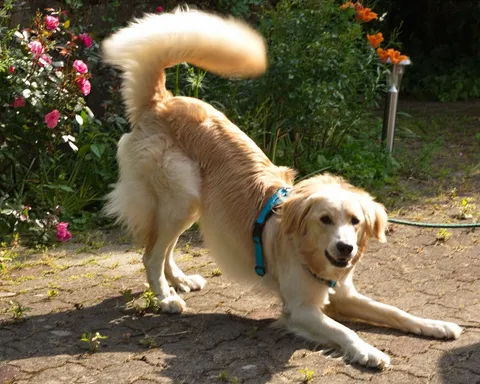
The play bow: front end down, rear up. Bouncy, exaggerated, inefficient movement. Open, relaxed mouth. An invitation that says, "What comes next is play."
Body lowered, weight shifted back, head low. Ears pinned back, tail low or tucked. Eyes may show white. The dog wants more distance.
Stiff, still body leaning forward. Tail high and rigid, sometimes with a fast, narrow wag. Hard stare. Raised hackles. Time to calmly create space.
Head to tail
The tail
Tail position is relative to each dog's natural carriage. A Beagle's normal tail is high; a Greyhound's is low. Read the change, not just the position.
Researchers found dogs wag more to the right when seeing their owner and more to the left when seeing an unfamiliar, assertive dog, and that other dogs react to the difference (Quaranta et al., 2007; Siniscalchi et al., 2013).
Subtle signals
Researchers have documented signals like lip licking, yawning, lowered posture, and paw lifting in stressed dogs (Beerda et al., 1997), and found that owners often notice the obvious signs but miss the subtle ones (Mariti et al., 2012). Each of these can also be normal behavior, so always read them in context.
Under pressure
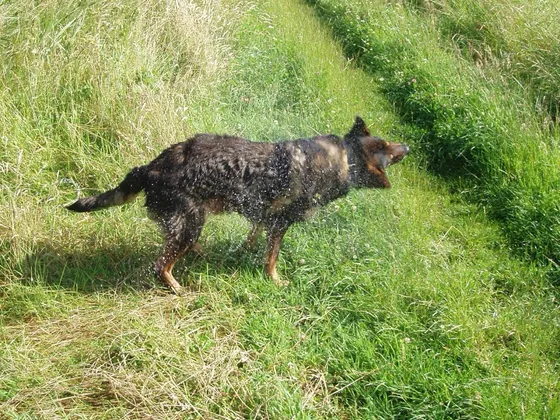
When a dog feels threatened or overwhelmed, it usually responds in one of four ways. Many dogs try the quieter options first. When those don't work, or aren't possible because the dog is on a leash, cornered, or held, a dog may move toward fight. Behavior scientists describe the same idea as the stress response, sometimes adding "freeze" and "fidget" (frantic, silly behavior) to the list.
What it looks like: Weight forward, hard stare, stiff body, raised hackles, growling, lip lift, snapping, lunging, or biting.
The dog has decided the best way to make the threat go away is to drive it off. Often happens when the other options have failed or aren't available, such as on a tight leash or in a corner.
What it looks like: Turning and running, pulling away on the leash, hiding behind the owner or furniture, trying to escape.
The dog wants distance and believes it can get it by leaving. Dogs prevented from fleeing may move to fight.
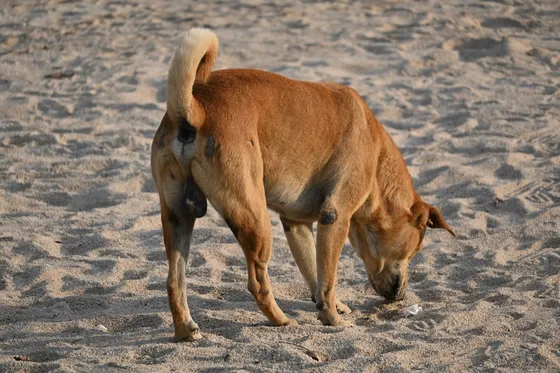
What it looks like: Turning the head or body away, sniffing the ground, scratching, yawning, moving in a curve instead of straight, ignoring the other dog or person.
The dog is trying to defuse the situation without leaving or fighting. These are often the first, quietest signals.
What it looks like: Lowering to the ground, rolling onto the back, tucking the tail, freezing, lip licking, squinting, or urinating.
The dog is shutting down or trying to appease. A still, "calm" dog is not always a comfortable dog. Give it space and lower the pressure.
Claiming
Dogs sometimes claim food, toys, chews, beds, furniture, doorways, a spot in the car, or even a person. Behavior professionals call this resource guarding. It is a natural behavior, but it can escalate if it isn't understood and handled well.
Keep children and other pets away while you work on guarding. If a dog has already bitten, or you're unsure, have a professional guide you through it the first time.
Stiff, still, weight over the item, hard stare: a dog saying "this is mine."
Two very different dogs
Most aggressive behavior comes from fear or insecurity: the dog is trying to make something scary go away. Less often, a confident dog uses aggression over space, resources, or a challenge. The body tells you which, and the plan for each is different.
| Signal | Insecure / fearful | Confident |
|---|---|---|
| Body weight | Back, ready to retreat | Forward, moving toward the trigger |
| Ears | Pinned back or to the side | Up and forward |
| Tail | Low or tucked | High and stiff, sometimes a fast, narrow wag |
| Mouth | Lips pulled back, long mouth corner | Lips pushed forward, short rounded mouth corner |
| Eyes | Whale eye, dilated pupils, looking away and back | Hard, direct stare |
| Behavior | Barks and backs up, lunges then retreats | Holds ground or advances, steady and deliberate |
| Driven by | Fear and insecurity: "Go away, I'm worried." | Confidence or conflict over space or resources: "This is mine. Back off." |
Many dogs show a mix, called conflicted behavior: for example, a dog that barks with its weight forward but its ears back and tail low. Conflicted dogs can be unpredictable, so give them space.
Barking
Research shows barks change with context. People can often tell what situation a bark was recorded in from sound alone, and pitch and the rhythm between barks shape how emotional it sounds (Pongrácz et al., 2005). Listen to the bark and watch the body together.
Alert bark or aggressive bark? An alert bark is short, checks in, and stops; the body stays fairly loose and the dog can be called away. An aggressive bark is lower and harsher, the body is stiff and forward, the stare is fixed, and the dog is hard to interrupt.
Play
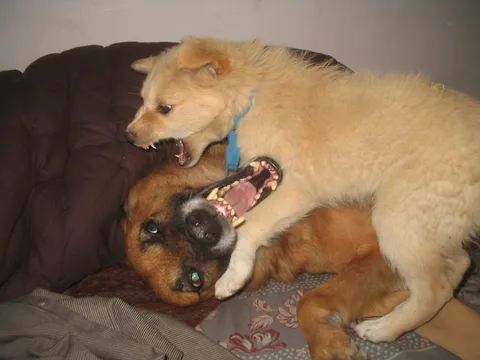
Healthy play can look rough and sound loud. What matters is that both dogs keep choosing to play. The play bow helps: dogs often use it right before or after rough moves so they aren't misread (Bekoff, 1995).
Test it: gently separate them. If the "underdog" comes right back for more, it's likely play.
Escalation
Veterinary behaviorist Kendal Shepherd described how dogs usually escalate step by step, starting with quiet signals. If the early signals are ignored, or punished away, a dog may skip straight to the top. The goal is to notice the bottom rungs and help the dog before it needs to climb.
Adapted from the "ladder of aggression," Shepherd, K. (2002), BSAVA Manual of Canine and Feline Behavioural Medicine.
See the individual
Breed and body type change how signals look. Read each dog against its own baseline.
Cropped ears (like many Cane Corsos and Dobermans) and long, heavy ears (like Basset Hounds) move less visibly. Watch the base of the ear and the forehead.
Docked tails give less information, and dogs read long tails more easily (Leaver & Reimchen, 2008). Curled tails (Akitas, Shibas, Pugs) sit high even when relaxed; watch for the curl loosening or dropping.
Mastiffs, Cane Corsos, and Shar-Peis have heavy lips and skin that can hide tension around the mouth and eyes. Watch the stillness of the whole face.
Brachycephalic breeds have limited facial expression and often pant more. Long coats (Komondor, Puli, Old English Sheepdog) can hide eyes and hackles.
On black dogs, eyes and facial changes are harder to see in photos and dim light. Rely on posture and movement.
Dogs evolved a muscle to raise the inner eyebrow, an expression that draws people in (Kaminski et al., 2019). It doesn't always mean sadness.
Common mistakes
A wagging tail means a happy dog.
A wag means the dog is emotionally engaged. A loose, sweeping wag is friendly; a high, stiff, fast wag can signal arousal or a warning.
The "guilty look" means my dog knows it did something wrong.
Research found dogs show the "guilty look" in response to the owner's scolding or body language, whether or not the dog actually misbehaved (Horowitz, 2009).
Raised hackles mean aggression.
Hackles signal arousal. A dog can raise its hackles from fear, excitement, or uncertainty.
A dog on its back always wants a belly rub.
Sometimes. It can also be an appeasement gesture from a worried dog. Check for a tense mouth, whale eye, or a tucked tail.
A yawning dog is tired.
Often, but dogs also yawn in stressful moments.
A growl is just bad behavior.
A growl is information: the dog is warning before doing more. Address what is causing the discomfort so the dog doesn't need to warn.
Evidence
In stressful situations, dogs showed lowered posture, lip licking, yawning, paw lifting, and restlessness.
Beerda, B., Schilder, M. B. H., van Hooff, J. A. R. A. M., & de Vries, H. W. (1997). Manifestations of chronic and acute stress in dogs. Applied Animal Behaviour Science, 52(3–4), 307–319. Read the study
Dogs wagged more to their right when seeing their owner and more to their left when facing an unfamiliar, assertive dog.
Quaranta, A., Siniscalchi, M., & Vallortigara, G. (2007). Asymmetric tail-wagging responses by dogs to different emotive stimuli. Current Biology, 17(6), R199–R201. Read the study
Dogs watching another dog wag more to the left had higher heart rates and more anxious behavior than when watching right-biased wags.
Siniscalchi, M., Lusito, R., Vallortigara, G., & Quaranta, A. (2013). Seeing left- or right-asymmetric tail wagging produces different emotional responses in dogs. Current Biology, 23(22), 2279–2282. Read the study
Play bows often appear right before or after rough actions like biting or shaking, helping keep play from being misread as aggression.
Bekoff, M. (1995). Play signals as punctuation: The structure of social play in canids. Behaviour, 132(5–6), 419–429. Read the study
Dogs approached a life-size model dog with a long wagging tail more readily than one with a short tail, suggesting tail length affects signaling.
Leaver, S. D. A., & Reimchen, T. E. (2008). Behavioural responses of Canis familiaris to different tail lengths of a remotely-controlled life-size dog replica. Behaviour, 145(3), 377–390. Read the study
Dogs have a small muscle that raises the inner eyebrow ("puppy dog eyes") that was not found in the wolves studied, and dogs make the movement far more often.
Kaminski, J., Waller, B. M., Diogo, R., Hartstone-Rose, A., & Burrows, A. M. (2019). Evolution of facial muscle anatomy in dogs. PNAS, 116(29), 14677–14681. Read the study
People identified the situation a bark was recorded in well above chance from sound alone. How emotional a bark sounded depended on its pitch and the gaps between barks.
Pongrácz, P., Molnár, C., Miklósi, Á., & Csányi, V. (2005). Human listeners are able to classify dog barks recorded in different situations. Journal of Comparative Psychology, 119(2), 136–144. Read the study
Owners readily recognized obvious stress signals but often missed subtle ones like yawning and nose licking.
Mariti, C., Gazzano, A., Moore, J. L., Baragli, P., Chelli, L., & Sighieri, C. (2012). Perception of dogs' stress by their owners. Journal of Veterinary Behavior, 7(4), 213–219. Read the study
Dogs showed the "guilty look" in response to their owner's scolding, whether or not they had actually disobeyed.
Horowitz, A. (2009). Disambiguating the "guilty look": Salient prompts to a familiar dog behaviour. Behavioural Processes, 81(3), 447–452. Read the study
We'll watch your dog in real situations, show you what they're saying, and teach you how to respond.
Start a conversation